JavaScript WeakRef: The Feature You Probably Shouldn't Use
A pragmatic look at weak references, garbage collection, and why 'just because you can' isn't always 'you should'.
On this page 6 sections
Most JavaScript developers go their entire careers without ever touching WeakRef. That is probably for the best. However, it is one of those corners of the language that reveals something deeper about how JavaScript actually works under the hood—and understanding it will make you a better developer, even if you never write new WeakRef(...) in production code.
What Is a WeakRef?
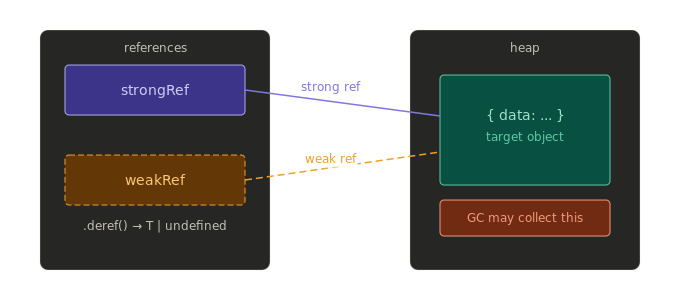
Normally when you assign an object to a variable, you create a strong reference. The JavaScript engine sees that reference and keeps the object alive. The object stays in memory until nothing is pointing to it anymore. Only then does the garbage collector reclaim that memory.
A WeakRef flips this behavior. It is a reference to an object that tells the garbage collector: “Do not keep this object alive just for me. If everyone else is done with it, feel free to clean it up.”
Create one like this:
const myObject = { name: "I might not be here long" };
const weakRef = new WeakRef(myObject);
When you want to use the object, call .deref():
const obj = weakRef.deref();
if (obj) {
  // Object still exists, use it
} else {
  // Object has been garbage collected
}
The conditional check is critical. The object might not be there anymore—that is the whole point of a weak reference.
The Big Caveat: Avoid When Possible
The people who proposed this feature for JavaScript explicitly recommend avoiding it when possible. That is an unusual position for an API’s own authors to take.
The skepticism exists because garbage collection is a genuinely hard problem, and the way engines handle it is neither predictable nor consistent. Here is what that means in practice:
- Two objects that become unreachable at the exact same moment might be cleaned up at wildly different times.
- Garbage collection work can be split up and spread out to avoid freezing your application.
- JavaScript engines use heuristics to balance memory usage against performance.
- Sometimes the engine holds onto references you do not even know about—things tucked away in closures or internal caches.
- Different engines behave differently. The same engine might behave differently across versions.
If your code depends on garbage collection happening at a specific time—or happening at all—you will have problems.
Important Behaviors
If you decide to use WeakRef, there are behaviors to internalize:
Objects stick around within a single job. If you just created a WeakRef or just called .deref() on one, that target object is guaranteed to stay alive until at least the end of the current JavaScript job (including any promise callbacks). This prevents code from accidentally observing garbage collection behavior, which would create portability nightmares across engines.
Multiple WeakRefs to the same object stay in sync. If you have two WeakRefs pointing at the same target, they always agree within the same job. You will not get the object from one and undefined from the other.
The target is permanent—until it is not. You cannot swap out what a WeakRef points to. Its target is set at creation and will only ever be that original object or, eventually, undefined.
The garbage collector might never collect. Just because nothing strongly references your object does not mean the engine will actually clean it up. It might stick around forever. WeakRef.deref() returning undefined is a possibility, not a guarantee.
For more on how JavaScript handles memory, read: Deep Dive into Object Memory Management in JavaScript.
Practical Example
A scenario where a weak reference makes sense: a counter that updates a DOM element, but should stop and clean itself up if that element gets removed from the page.
class Counter {
  constructor(element) {
    this.ref = new WeakRef(element);
    this.start();
  }

  start() {
    if (this.timer) return;
    this.count = 0;

    const tick = () => {
      const element = this.ref.deref();
      if (element) {
        element.textContent = ++this.count;
      } else {
        console.log("The element is gone.");
        this.stop();
        this.ref = null;
      }
    };

    tick();
    this.timer = setInterval(tick, 1000);
  }

  stop() {
    if (this.timer) {
      clearInterval(this.timer);
      this.timer = 0;
    }
  }
}

const counter = new Counter(document.getElementById("counter"));

setTimeout(() => {
  document.getElementById("counter").remove();
}, 5000);
If the counter element disappears, the Counter class does not artificially keep it alive. The weak reference lets the browser reclaim that memory naturally.
Could you solve this with a simple strong reference and a manual cleanup method? Absolutely—and in most cases, that is the better approach because it is explicit and predictable. WeakRef is for the narrow set of situations where you genuinely cannot control the lifecycle of the thing you are referencing.
When to Use It
Legitimate use cases exist, but they are specialized:
- Caches where cached entries should be allowed to disappear under memory pressure rather than growing indefinitely.
- Mappings from objects you do not own to associated metadata, where you want the metadata to go away with the object.
- Observer-like patterns where the observer does not want to keep its targets alive.
All of these involve relationships where you genuinely do not want your code to dictate object lifetimes.
The Takeaway
WeakRef is more valuable as a concept than as a tool. Understanding it teaches you something important about JavaScript: memory management is real, references have different strengths, and the runtime is doing a lot of invisible work to keep your programs running.
In day-to-day work, reach for it sparingly. If you find yourself typing new WeakRef, take a breath and ask whether you can restructure your code to make ownership explicit instead. Nine times out of ten, you can. That tenth time is where WeakRef earns its keep.
Related: Node.js Memory Management and Debugging covers how V8 handles memory and garbage collection in production applications.